

Tank Cycling
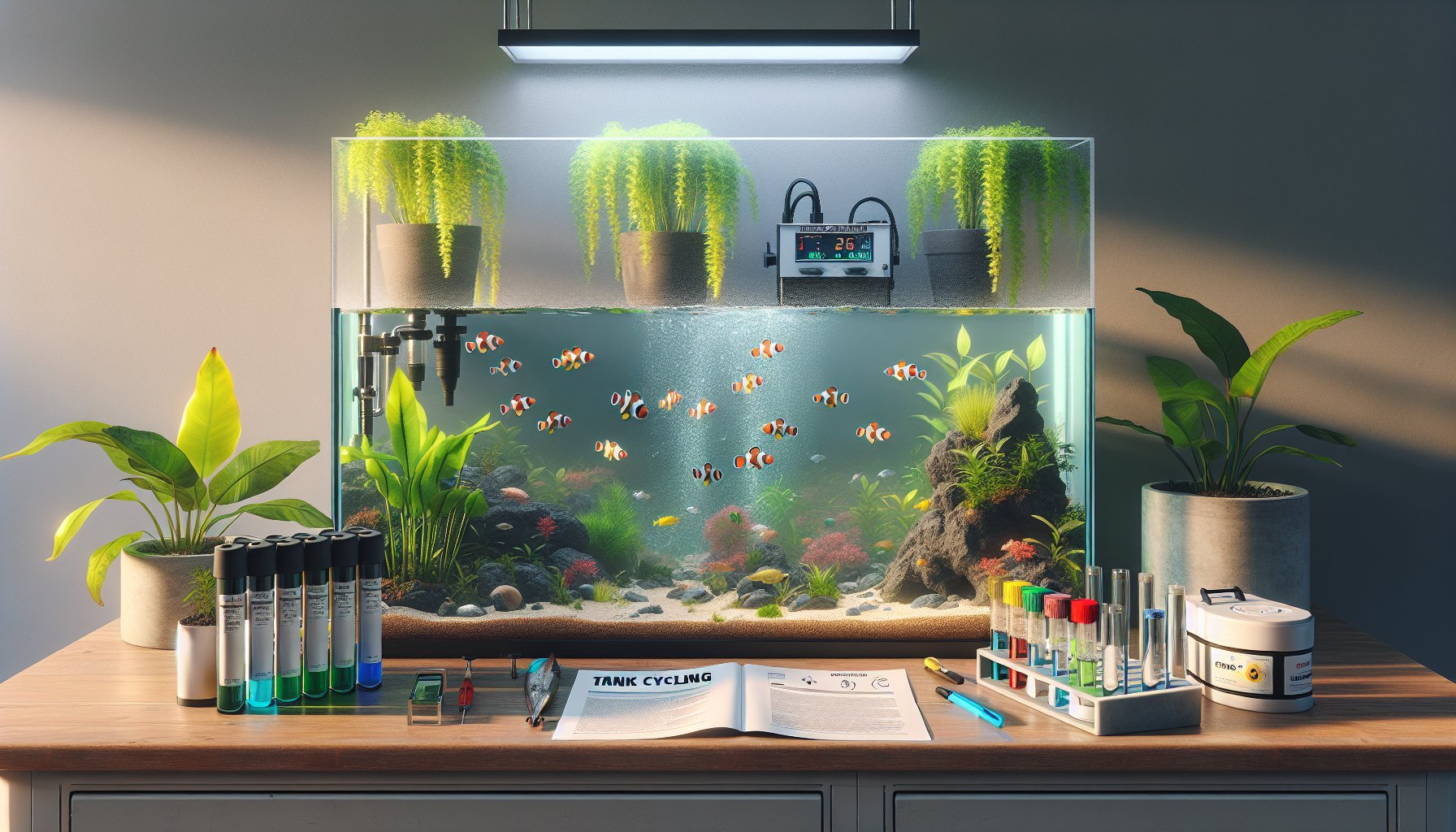
Quick Summary
Tank cycling is the essential process of preparing your aquarium so it can safely support fish. Before any livestock goes in, beneficial bacteria need time to grow and establish the nitrogen cycle. These bacteria convert harmful ammonia from fish waste into nitrite, and then into the far less toxic nitrate. A proper cycle usually takes several weeks and involves testing your water regularly to track ammonia, nitrite, and nitrate levels. Rushing this step can stress or even kill fish, so patience here pays off with a stable, healthy tank. Once ammonia and nitrite consistently read zero and nitrates are present, your aquarium is ready for its first residents.
Key takeaways
- Cycle the tank before adding fish so helpful bacteria can grow and handle waste safely.
- Feed the cycle with an ammonia source and keep the filter running 24/7 to build up the bacteria.
- Test ammonia, nitrite, and nitrate regularly; a normal cycle often takes several weeks.
- Add fish only when ammonia and nitrite read 0 for several days in a row and nitrate is showing up.
- Do partial water changes if nitrate gets high, and keep up routine maintenance to protect the cycle.
Tank Cycling (the part nobody wants to wait for... but you'll be glad you did)
Tank cycling is basically you growing a microscopic clean-up crew before you add fish. You're setting up the nitrogen cycle so ammonia (from waste/food/decay) gets converted to nitrite, and then to nitrate. Ammonia and nitrite are the scary ones. Nitrate is way easier to manage with water changes and plants.
If you've ever heard someone say "my fish died for no reason a few days after I bought them," there's a good chance they dropped fish into an uncycled tank and got hit with ammonia or nitrite spikes. Cycling is you avoiding that whole mess.
What "cycled" actually means
You can add a measured ammonia source, and within ~24 hours your test reads: ammonia 0 ppm, nitrite 0 ppm, and you've got some nitrate showing up. That's the green light.
The nitrogen cycle in plain English
Think of it like a two-step relay race. Step one bacteria eat ammonia and spit out nitrite. Step two bacteria eat nitrite and spit out nitrate. Early on, you'll see ammonia rise, then nitrite rises, then nitrate rises. The "done" point is when ammonia and nitrite stop hanging around and nitrate is the only thing that builds up.
- Ammonia (NH3/NH4+): fish waste, rotting food, dead plant bits. Toxic fast.
- Nitrite (NO2-): produced by the first bacteria group. Also toxic fast.
- Nitrate (NO3-): produced by the second bacteria group. Manageable with water changes/plants.
Clear water means nothing
A tank can look sparkling and still be full of ammonia or nitrite. Your eyes don't cycle a tank-your test kit does.
What you need before you start
You don't need a lab, but a few basics make cycling way smoother. Most "cycling problems" I see are really just missing tools or inconsistent testing.
- A liquid test kit for ammonia, nitrite, nitrate (liquid kits are usually easier to read than strips)
- Dechlorinator (chlorine/chloramine can mess with your bacteria and your fish later)
- A filter with some kind of media (sponge/ceramic/biomedia) for bacteria to live on
- Heater if you're cycling a tropical tank (bacteria work faster when it's warm)
- An ammonia source (pure ammonia or fish food), plus a measuring dropper/pipette if you're dosing
Set yourself up for easy maintenance
If your filter uses cartridges, I swap to a sponge + biomedia setup early. Cartridges encourage you to toss the very stuff your bacteria are living on.
Fishless cycling (my go-to method)
Fishless cycling is exactly what it sounds like: you feed the bacteria without putting any fish through the ugly part. It's calmer, more controllable, and you can fully stock gradually once the tank proves it can process waste.
Step-by-step: cycle with pure ammonia
This is the cleanest way I've found. You're dosing a known amount, testing, and watching the tank learn to process it.
- Fill the tank, turn on filter/heater, and dechlorinate the full volume (don't skip this).
- Bring temp up if needed (mid-to-upper 70s°F / ~24-26°C is a comfortable range for most tropical setups).
- Dose ammonia to about 1-2 ppm to start (more isn't better; you're trying to grow bacteria, not pickle them).
- Test daily or every other day: ammonia, nitrite, nitrate. Write it down-patterns matter more than single readings.
- When ammonia starts dropping and nitrite shows up, keep feeding small doses of ammonia so the bacteria don't starve.
- Once nitrite finally starts dropping too, you'll see nitrate climbing. This is the 'late game.'
- The finish line: you dose ammonia (same amount), and within ~24 hours ammonia = 0 and nitrite = 0.
- Do a big water change to bring nitrate down (often 50-80% depending on your reading), then you're ready for your first fish.
Don't blast ammonia sky-high
If you dose up to 4-8+ ppm, cycling can actually drag out or stall. High ammonia can slow bacteria growth and make nitrite spikes nastier.
Step-by-step: cycle with fish food (the low-tech option)
If you don't want to hunt down pure ammonia, fish food works. It's just messier and harder to measure because you're waiting for it to rot into ammonia.
- Start the tank like normal: filter on, heater if needed, dechlorinate.
- Drop in a small pinch of food every day or two (imagine you're feeding an invisible fish).
- Test ammonia/nitrite/nitrate regularly.
- If ammonia never shows up, add a little more food. If the tank smells like a dumpster, you added way too much.
- Keep going until you can add food and see ammonia + nitrite return to zero consistently.
Control the stink
A little food goes a long way. If you're getting cloudy water and funk, pull out uneaten clumps with a net and reduce feeding.
Using bottled bacteria & seeded media (the speed boosters)
Bottled bacteria can help, and seeded media can help a lot-like, "cut weeks down to days" a lot-if it's coming from a healthy, established tank. The key is that bacteria live on surfaces, not in the water column. So filter media from a cycled tank is gold.
- Best booster: a used sponge/ceramic media from a trusted, disease-free tank
- Good booster: a handful of established filter gunk squeezed into your filter (sounds gross because it is)
- Sometimes helpful: bottled bacteria (varies by brand, age, shipping temps)
Be picky about "free cycled media"
If the donor tank has ich, worms, or mystery deaths, you can import that along with the bacteria. Only take media from tanks you trust.
How long cycling takes (and what affects it)
Most brand-new tanks take a few weeks. Sometimes it's faster with seeded media. Sometimes it drags on because of cold temps, inconsistent ammonia dosing, or you accidentally nuked bacteria with chlorine.
- Temperature: warmer (within reason) usually speeds things up
- Chlorine/chloramine exposure: can knock bacteria back hard
- Filter flow & oxygen: bacteria like oxygenated water moving through media
- Ammonia level: moderate is better than extreme
- Seeding: established media is the biggest shortcut
Reading your test results without losing your mind
This is the part that trips people up: the numbers look "bad" for a while, and that's normal during a fishless cycle. You're basically watching the tank learn.
The usual timeline (roughly)
- Phase 1: Ammonia rises and hangs around
- Phase 2: Nitrite shows up and often goes very high (this phase can feel like it lasts forever)
- Phase 3: Nitrate climbs, nitrite starts dropping, and things finally look like progress
- Finish: You can "feed" ammonia and it disappears quickly with nitrite following
About that nitrite spike
Nitrite can peg the chart during a fishless cycle. It looks alarming, but with no fish in the tank it's mostly just a patience game. Keep the filter running and keep testing.
If you're using a liquid kit, nitrate testing often needs serious shaking (especially bottle #2 on many kits). If your nitrate always reads zero no matter what, it's usually user error before it's a "mystery tank."
Common mistakes (I've made some of these so you don't have to)
- Adding fish because the water "looks fine"
- Changing filter media during the cycle (that's where the bacteria are building)
- Not dechlorinating new water before topping off or doing changes
- Dosing way too much ammonia and stalling progress
- Testing once a week and guessing the rest of the time
- Letting the ammonia source run out for long stretches (bacteria population shrinks back)
- Turning the filter off overnight (bacteria need oxygenated flow)
Never rinse filter media under tap water
Tap water can carry chlorine/chloramine. If you need to clean a sponge or biomedia, swish it in old tank water you just removed during a water change.
Do you ever do water changes during a fishless cycle?
Sometimes, yeah. Not because you're protecting fish, but because you're keeping the cycle moving. If nitrate gets extremely high, or you accidentally overdosed ammonia, a water change can bring levels back into a range where bacteria keep multiplying instead of getting slowed down.
- If you overdosed ammonia: do a partial water change and re-dose to a reasonable level
- If nitrate is sky-high late in the cycle: change water so you're not starting your first fish at 80-150+ ppm nitrate
- If you're cycling with food and it's turning into sludge: siphon debris and reset your approach
Big water change at the end is normal
After the tank can process ammonia reliably, I usually do a large water change to knock nitrates down, then I add fish soon after so the bacteria don't sit there starving.
Fish-in cycling (not my first choice, but sometimes it happens)
Maybe you inherited a tank, or you already bought fish (we've all seen the "starter kit + fish" combo). Fish-in cycling is basically damage control: you're keeping ammonia and nitrite as low as you can while bacteria catch up.
If you can return/rehome the fish temporarily, do it
A fishless cycle is calmer for you and way kinder to the fish. If you have a cycled quarantine tank or a friend who can hold them, that's the easiest fix.
If you must do fish-in, here's the practical routine
- Test ammonia and nitrite daily (yes, daily).
- Do water changes whenever ammonia or nitrite show up (a lot of people aim to keep both at 0; at minimum keep them very low).
- Feed lightly. Overfeeding turns into ammonia fast.
- Add bottled bacteria if you want, but don't use it as an excuse to skip testing.
- Don't add more fish until readings have been stable for a while.
If your tap water has chloramine, it can show up as ammonia on some tests depending on the kit and conditioner. If your readings are confusing, test your tap water too so you know what you're starting with.
How to know you're ready for fish (and how many to add first)
The tank is ready when it processes your "feed" (ammonia dose or food waste) quickly and predictably. For most community tanks, I still like to add the first fish in a reasonable first group, not the entire dream stocking list in one afternoon.
- Ammonia reads 0 ppm
- Nitrite reads 0 ppm
- Nitrate is present (not zero), and you can lower it with a water change
- You can add your ammonia dose and get back to 0/0 within about a day
Add fish soon after the cycle proves itself
Once you stop dosing ammonia, the bacteria population shrinks. I like to finish the cycle, do the big water change, and add the first residents within a day or two.
After cycling: keeping the cycle stable long-term
Cycling isn't a one-time magical event. It's a living colony that adjusts to how much waste your tank produces. If you suddenly double the bioload, the bacteria need time to ramp up.
- Avoid replacing all filter media at once; clean it gently in removed tank water instead
- Don't deep-clean the tank and scrub everything spotless in one day
- Add fish in stages (especially in smaller tanks)
- Keep an eye on nitrate and do regular water changes
- If you medicate, remember some meds can affect your biofilter-test more during/after
Quick troubleshooting (because cycling loves to be weird)
"My ammonia won't go down"
- Check you dechlorinated (including top-offs).
- Make sure the filter is running 24/7 with decent flow.
- Confirm your ammonia isn't insanely high-do a water change if it is.
- Warm the tank a bit if it's cold (for tropical setups).
- Consider seeding with established media.
"Nitrite has been high forever"
- This is common. Keep feeding small amounts of ammonia so bacteria don't starve.
- Double-check nitrate test steps (shaking bottles, timing).
- If nitrite is maxed out and you're stalled for weeks, a partial water change can sometimes help bring it down into a range where the second bacteria group ramps up.
"Nitrate is zero but I swear the cycle is happening"
- Retest and follow the nitrate test directions exactly (shake like you mean it).
- Make sure you're not doing constant giant water changes that keep nitrate diluted to nothing.
- If you have lots of fast-growing plants, they can eat nitrate-still, you should see some movement somewhere in the numbers.
The "cycle crashed" fear
Most of the time, it didn't crash-it just shrank. Big media swaps, long filter shutoffs, or chlorine exposure are the common real crash causes.
My simple cycling checklist
- Dechlorinate the full tank volume.
- Run filter 24/7; keep temp reasonable for your setup.
- Pick an ammonia source (pure ammonia is easiest to measure).
- Test and log ammonia/nitrite/nitrate every day or two.
- Don't replace filter media; don't rinse it in tap water.
- Finish with an ammonia "24-hour test," then do a big water change.
- Add your first fish group, then keep testing for the first week.
Found this guide helpful? Browse more topics.
Back to Aquarium Guides